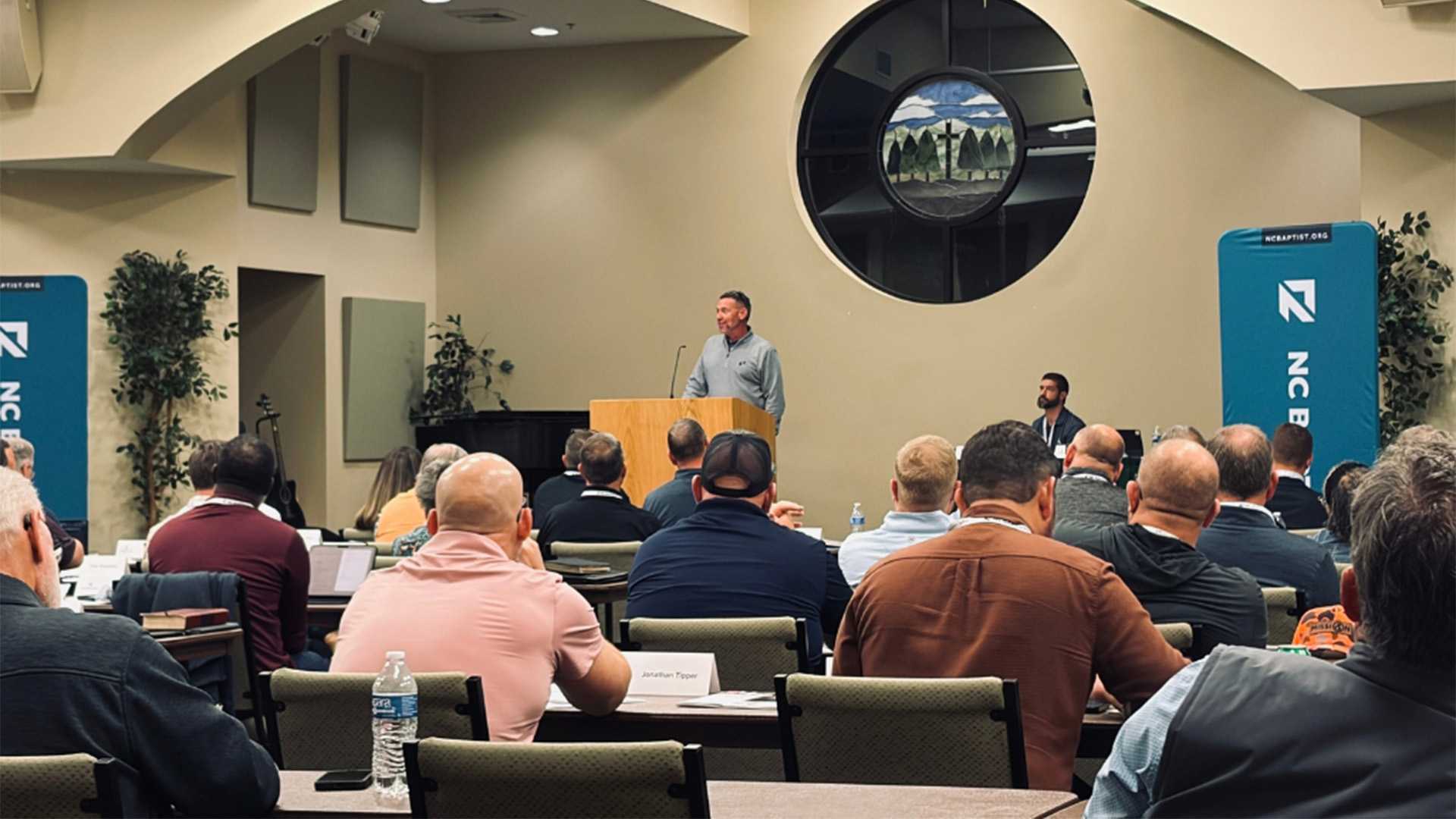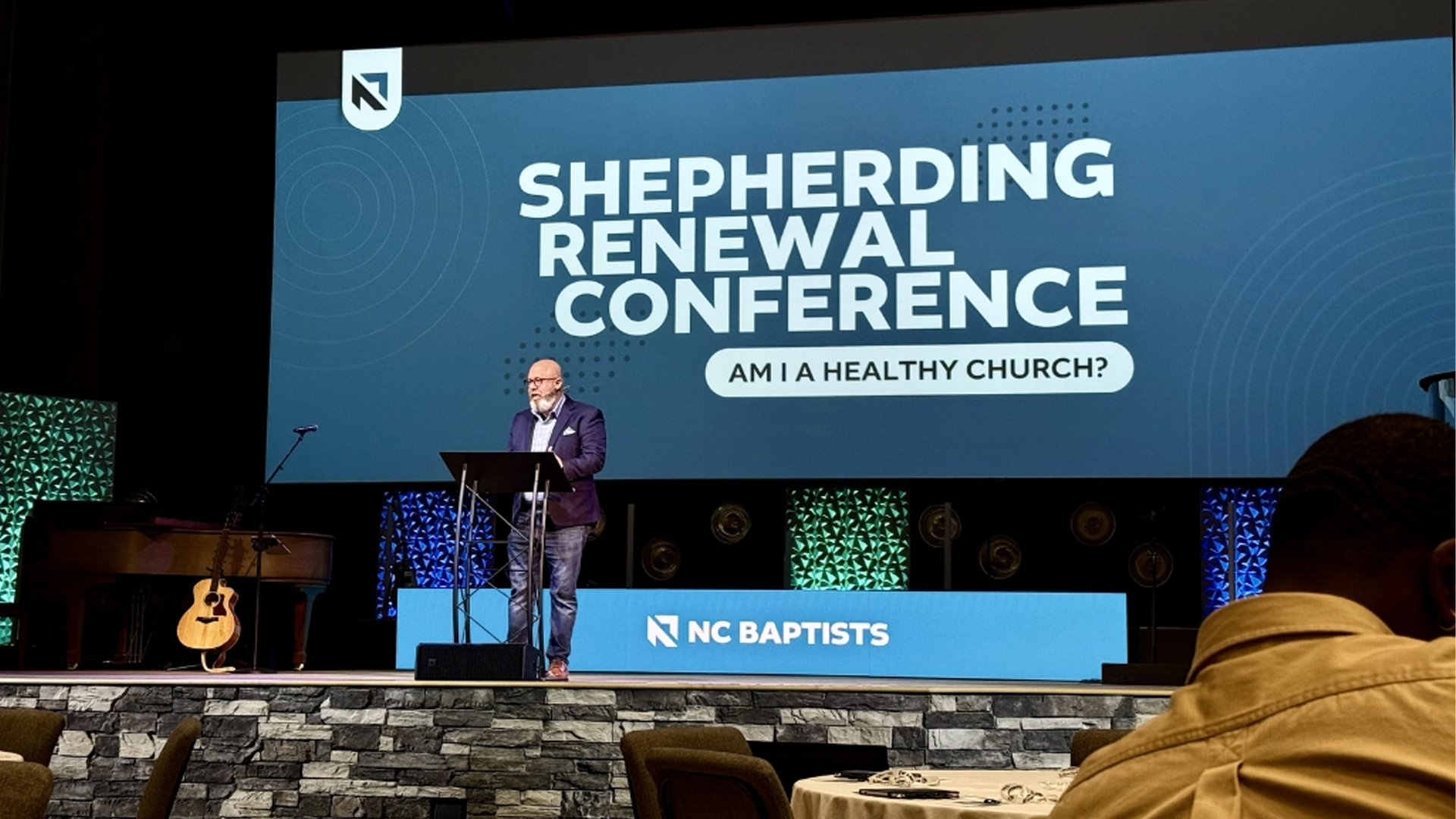
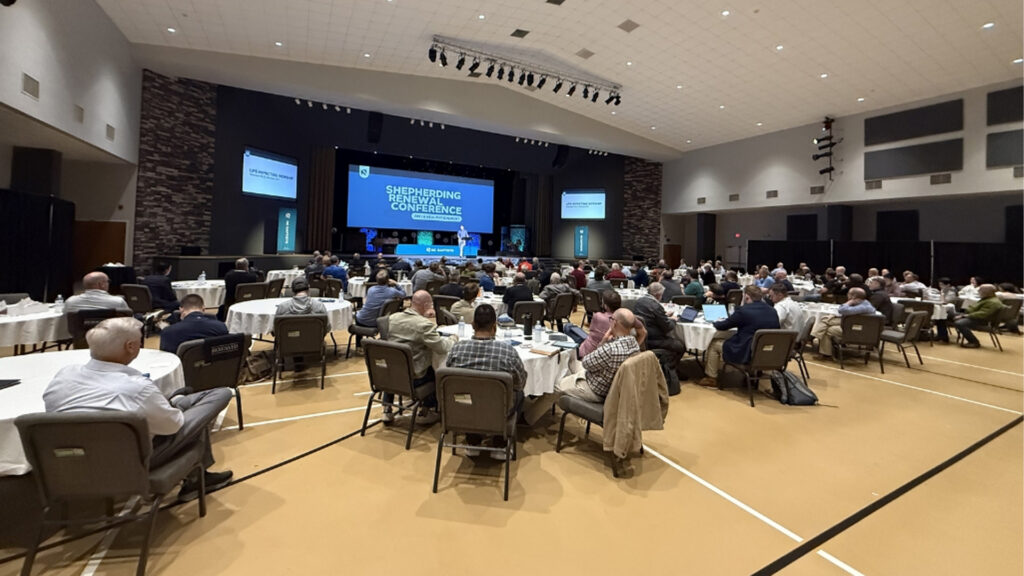
More than 100 pastors and ministry leaders gathered at Faith Baptist Church on April 30 for the “Shepherding Renewal Conference,” a one-day event focused on biblical and practical approaches to church revitalization inspired by a new book by the same name.
More than 100 pastors and ministry leaders gathered at Faith Baptist Church on April 30 for the “Shepherding Renewal Conference,” a one-day event focused on biblical and practical approaches to church revitalization inspired by a new book by the same name.
The conference featured sessions by the book’s authors — N.C. Baptist pastors Matt Capps and Steven Wade. Capps serves as lead pastor of Fairview Baptist Church in Apex, and Wade is the lead pastor of Faith Baptist Church in Youngsville where the conference was held.
The event also featured sessions with N.C. Baptist ministry strategists Sandy Marks and Terry Long, who both served in pastoral ministry before their current roles. Marks serves as the state convention’s pastoral ministry strategist, while Long serves as the church health and revitalization strategist.
With multiple recent studies suggesting that approximately 80% of churches in the United States are either plateaued or declining, most churches are in need of some form of revitalization. Speakers shared from their own experiences in pastoral ministry. Conference attendees also received an advance copy of Capps’ and Wade’s book, “Shepherding Renewal: A Guide to Church Revitalization,” which released May 12.
Leading people while leading change
In the opening session, Capps addressed leading others through the many changes that come with church revitalization. Capps underscored the biblical metaphor of the pastor as a shepherd, a leader who walks closely alongside his flock, knows them intimately and helps them through struggles. He also noted that many pastors aren’t always prepared for the challenges of leading people through change.
“Change doesn’t come easy,” Capps said. “When you are changing things at a church, you are not just changing systems, you’re unsettling people. And every pastor feels this tension because at a church, change is not about methods, it’s not about the structure or the systems, it’s about people’s stories, it’s about their memories, it’s about their sense of belonging.”
Capps said 1 Thessalonians 5:14 provides a helpful framework for shepherding people through change in the verse’s exhortation to “warn those who are idle, comfort the discouraged, help the weak, (and) be patient with everyone” (CSB). He then gave five practical ways pastors can lead their congregation through change. They were:
- Let people know why change is coming.
- Move intentionally and create confidence with the change.
- Make space for open dialogue.
- Pursue unity, even without uniformity.
- Remain steadfast in pursuit of growth.
The centrality of the Word of God in revitalization
In the second session, Wade spoke on the importance of keeping God’s Word at the center of the entire revitalization effort. To illustrate this point, Wade read from Nehemiah 8, where the Jewish people brought Ezra the Law and had him read it while they listened, celebrated and acted on the Word of God.

Wade said Nehemiah 8 illustrates a pattern later associated with Christians who center their lives on Scripture, an idea often summarized by the phrase “people of the book” that has long influenced Protestant views on biblical authority. With the Bible viewed as the highest authority for faith and practice, the clearest sign of a healthy church is one that is “centered on… dependent on… and guided by the Word of God,” Wade said.
Wade said the Jews in the book of Nehemiah demonstrate what it means to center the Word of God in our life through their gathering, honoring, attentiveness, celebration and response to the Scripture. Lasting renewal begins with lives centered on Scripture because only God’s Word can sustain the work of revitalization, Wade said.
Am I a healthy pastor?
In the third session, Marks addressed healthy leadership by asking attendees the question, “Am I a healthy pastor?” Marks anchored his message on 1 Timothy 4:16, in which the Apostle Paul writes to Timothy to encourage him in his role as a minister by paying attention to himself and attending to the spiritual gifts he had been given.
“Paul writes to (Timothy) not as an apostle but as a spiritual father,” Marks said. “It’s like (Paul is) saying, ‘If you are going to lead well, if you are going to bless, if you are going to do this ministry and finish strong, this is what matters most.’”
Marks noted that Paul did not instruct Timothy to fix the church’s systems or programs first. He started by calling Timothy’s attention to his life and doctrine.
“It is vitally important that we make an obvious observation right at the beginning,” Marks said “Paul does not first tell Timothy to fix the church. He doesn’t start with strategy, he doesn’t start with systems, he doesn’t start with attendance, programs and structures. He starts with Timothy.
“The greatest threat to your ministry is not out there, it’s in here,” Marks said, gesturing to his heart.
Marks said the question every leader must answer is “Am I a healthy leader?” Recognizing the difficulty that comes with church revitalization, Marks outlined the downward spiral that many pastors find themselves in by highlighting several hallmarks of a leader losing their health. These include pastors distancing themselves from their families, becoming obsessed with numbers and success, and jealousy for other leaders.
To stay healthy during church revitalization, Marks said leaders should center their walk with God and fight for it every day. Leaders should also find time to do things for themselves and their family. Lastly, leaders must remember the greater kingdom of God over their own church by celebrating successes in other congregations and not harboring resentment or jealousy.
Are we a healthy church?
In the fourth and final session, Long spoke on healthy churches. In his introduction, he equated the journey of church revitalization to traveling with a GPS. “It feels like a lot of our churches are perishing because they don’t know where to go,” Long said.
Long shared six markers of a healthy church, adding that church health depends on the church remembering and acting on those principles. The markers included things like maintaining a biblical community, having Christlike disciples, upholding biblical doctrine, and having leaders that equip and empower the congregation.
Returning to the GPS analogy, Long said understanding where your church currently is in the journey is the first step in cultivating and maintaining a healthy congregation. Long introduced a church health assessment available through the Baptist State Convention of North Carolina that can help pastors and church leaders determine where they are and steps to take in the future. Long encouraged church leaders to complete the assessment, pray over the results and consider next steps for the congregation.
“I believe that if every one of our churches would look in the Word of God for what a healthy disciple is and start planning their programming and their focus on that, and what a healthy church is and start using that for all decisions, it would change our entire state,” Long said.
By Stephen Halley, BR Editorial Aide
EDITOR’S NOTE — Access to the N.C. Baptist church health assessment is available online. More information about the “Shepherding Renewal” book is available at shepherdingrenewal.com. This article originally appeared on brnow.org. In the featured image, Pastor Matt Capps, one of the authors of the book “Shepherding Renewal”, speaks about leading the church through change during N.C. Baptists Shepherding Renewal Conference on April 30.